Real-Time Data Warehouse Architecture Patterns
Choose the right real-time pattern before complexity and cost spiral.
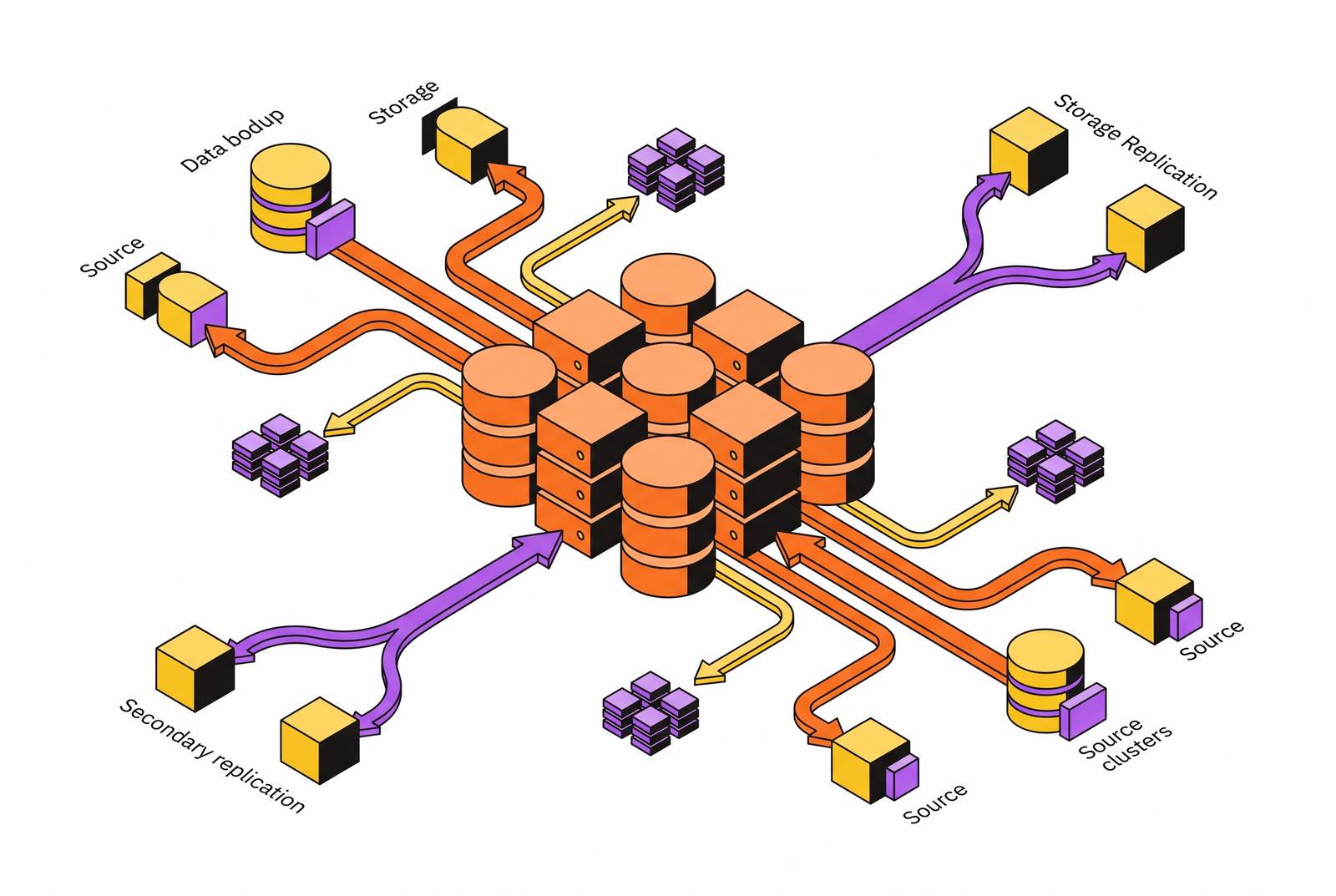
Real-Time Data Warehouse Architecture Patterns.
Why real-time data warehousing has moved from a niche capability to a baseline expectation
Real-time data warehouse architecture is not one design; it's a family of patterns, CDC-based streaming, event-driven ingestion, Lambda, Kappa, and lakehouse streaming, and each carries its own latency profile, its own way of breaking, and its own operating cost. The label "real-time" itself covers a wide range, anywhere from milliseconds to minutes depending on what the business actually needs and how much complexity a team is willing to run, so treating it as a single category from the start is a mistake. The commitment behind this shift is significant, as Confluent's Data Streaming Report, drawn from 4,175 IT leaders across 12 countries, finds that 44% of organizations report a 5x return on investment from real-time streaming initiatives, and 86% call it a critical or highly important strategic priority 2025 Data Streaming Report by Confluent.
That commitment has a harder edge to it once AI enters the picture addepto.com. Addepto's 2026 analysis puts the failure rate of AI projects reaching meaningful production above 80%, and Gartner's own estimate is that 60% of AI projects lacking AI-ready data get abandoned before they ever ship addepto.com. Real-time infrastructure, in other words, stopped being a reporting nicety a while back. It's a prerequisite for anything an organization wants to do with machine learning, and skipping it doesn't save money later, it just moves the failure downstream addepto.com.
Getting this wrong raises the infrastructure bill too. The platform changed. The pipeline thinking behind it didn't, and that gap is exactly where the money leaked out.
IBM's 2026 observation on "modern data stack fatigue" points at a related problem: stacking point solutions for ingestion, transformation, cataloging, orchestration, observability, and BI on top of each other created so much integration overhead that the tools ended up costing more engineering time than they saved. That's the case for choosing an architecture pattern on purpose, rather than bolting one more tool onto the pile because it solved last quarter's problem. This piece maps the family of patterns now in production, their latency profiles, where they fail, and what they cost to run, so a team can make that choice with its eyes open rather than defaulting to whatever's fashionable this year. In contrast with the cost of inaction, organizations that migrated to cloud warehouses without rethinking pipelines found cloud spend 2–4× their original on-premises costs with equivalent performance, since the platform changed but the pipeline thinking didn't scnsoft.com.
The five patterns that define real-time warehouse architecture today
Five patterns dominate current production architecture, and each deserves a plain, one-line description before anything else. Lambda runs a batch layer and a speed layer side by side, reconciling them at serving time. Kappa collapses that into a single stream pipeline, treating the event log itself as the record of truth. Medallion, nested inside a lakehouse, moves data through raw, cleaned, and business-ready tiers. CDC-based streaming reads changes directly off a database's write-ahead log or its equivalent. Event-driven ingestion has the application itself publish events rather than waiting for a database row to change.
None of these live in isolation in a real production system. Architectures in the field borrow from more than one of these patterns at once, and Medallion running inside a lakehouse has become the standard shape teams reach for by 2026. Treat the five as layers to compose rather than five separate products to pick between.
Latency gives the clearest organizing line. Log-based CDC and Kappa are in the sub-second range, event-driven ingestion typically runs in low minutes, and Lambda's batch layer, along with older query-based polling, spans minutes to hours.
Latency alone doesn't decide the pattern, though. The shape of the source system does too. The source dictates which patterns are even on the table before latency requirements enter the conversation.
The research behind this piece converges by 2026 on a specific consensus: standardize ingestion across batch, streaming, and CDC, land all of it into a lakehouse, and expose governed views through a fabric layer, rather than stacking a fourth parallel warehouse on top of an already tangled stack. That's the frame the rest of this piece works from.
Lambda architecture: where it still earns its operational complexity
Lambda's structure is two pipelines running in parallel: a batch layer optimized for historical accuracy, and a speed layer optimized for low latency, both feeding into a serving layer that reconciles the two. The idea sounds clean on a whiteboard. Running it is not.
One pipeline changes a field type, the other doesn't catch up, and the serving layer starts reconciling numbers that were never meant to match.
Lambda earns its complexity in specific, narrow circumstances: fraud detection systems that need millisecond alerting on one side and accurate daily BI rollups on the other are the textbook case, and usually it's teams already bumping against the limits of a single pipeline that reach for it. Outside that constraint, Lambda doesn't pay for itself. If nothing about the current single-pipeline setup is actually blocking the business, adding a second parallel pipeline just adds weight without adding value.
The operational cost is doubled in a very literal sense: two engineering teams, or at minimum two operational runbooks, and an outage's blast radius that's twice as wide as a single-pipeline system. None of that should read as a case against Lambda. It should read as a case against reaching for Lambda as a starting point. Lambda is a pattern teams graduate into once specific constraints force the issue, not a default anyone should build from day one.
Kappa architecture: one pipeline, events as the source of truth
Kappa strips Lambda down to a single stream pipeline. Historical reprocessing happens by replaying the event log itself, rather than running a second, separate batch job to cover the same ground.
Events are the source of truth, and that mental shift is what underlies Kappa. When data is naturally event-shaped to begin with, clicks, sensor readings, financial transactions, Kappa lines up with the domain almost immediately. Clickstream analytics at companies like LinkedIn is the textbook case cited for this pattern.
The tradeoff Lambda never has to face appears the moment someone needs a serious historical backfill. Reprocessing logic has to live inside the stream processing framework itself, and complex backfills can get unwieldy fast, a fact teams tend to discover only when they're staring down a bug that requires replaying six months of events.
Latency for real-time consumers is in the sub-second to low-second range, though reprocessing latency depends entirely on how deep the log goes and how much processing throughput is available. But that simplicity comes with a concentration risk. The stream processing framework becomes the single point of failure for the entire pipeline.
Medallion architecture inside a lakehouse: the pattern most teams are running
Medallion organizes data into three tiers, commonly called Bronze, Silver, and Gold: raw as it lands, cleaned and validated, then business-ready. Each tier adds a layer of trust and, usually, sheds volume, since raw data gets filtered and aggregated on its way up.
By 2026, Medallion inside a lakehouse has become so common because the lakehouse supplies the transactional and structural guarantees that make the tiering scheme workable, not because of the tiering scheme on its own. Open table formats like Apache Iceberg and Delta Lake bring ACID transactions, time travel, and schema enforcement to what used to be a loosely structured file lake, and that substrate is what makes Medallion's tier boundaries actually enforceable rather than aspirational.
The payoff shows up in Databricks' own account of the modernization: organizations that successfully modernize commonly cut infrastructure maintenance costs by 30 to 50%, and compress query latency from hours down to seconds Data Warehouse Modernization: Roadmap, Architecture, and Services. That's a substantial gain, and it's exactly why the pattern has spread as fast as it has.
None of it comes free. This is still, relatively speaking, a young paradigm, and the tooling is maturing quickly, but platform discipline matters enormously; a team that adopts a lakehouse without governance discipline just rebuilds the old data swamp inside a nicer file format. Schema enforcement at each tier boundary is only as good as the pipeline enforcing it, time travel is genuinely useful but its storage retention has a real cost attached, and compaction jobs on Iceberg or Delta tables (the OPTIMIZE operation) add operational overhead that teams routinely forget to budget for.
The AI angle ties back to where this piece started. The 2026 consensus treats the lakehouse as the place AI-ready data actually lives, since ML training, retrieval-augmented generation pipelines, and agent memory stores all benefit from pulling against one governed surface instead of a scatter of one-off exports. The lakehouse's core promise is that SQL analytics and ML workloads run on the same data and same storage, eliminating the lake vs. warehouse fork that made earlier architectures brittle.
CDC-based streaming: how log-based replication dominates production ingestion
Change data capture, precisely defined, means continuously identifying inserts, updates, and deletes in a source system and propagating only those changes downstream, not snapshots, not full table scans. That distinction is the whole point of the pattern: instead of asking "what does the table look like now," CDC asks "what just changed," and only moves the delta.
Three variants of CDC exist, and they are not equally viable in production. Log-based CDC reads from the WAL/oplog, captures exactly what was committed in correct order, places the lowest overhead on source systems, and captures deletes (this is what most practitioners mean when they say "CDC"). Trigger-based CDC writes changes into a side table or queue instead, so no log access is required. But every write now carries trigger overhead, and a schema change can break the whole setup without warning. It's viable, but fragile.
Putting a stream broker between the CDC source and the eventual target lets one pipeline serve both real-time and batch consumers at once, rather than building separate pipelines for each latency requirement.
Regulated industries lean on CDC for reasons beyond latency. In banking and healthcare, streaming every change event to a separate log gives compliance teams a durable, verifiable audit trail, every insert, update, and delete recorded as its own event.
Building this in-house is a real undertaking, not a weekend project. Running Kafka clusters, managing connectors, and writing consumer code all carry ongoing operational cost, and managed replication services exist specifically to remove that layer, giving teams production-grade streaming without a two-year internal build. Timestamp/query-based (legacy) approaches compare snapshots to detect changes, making deletes invisible and bounding latency by poll frequency, the weakest pattern, effectively batch ETL with a shorter interval. The initial snapshot strategy takes a snapshot from a known point in time, then reads all subsequent changes from the WAL, capturing the most complete history possible. Destination apply patterns include Stage → MERGE, which lands change events in a staging/delta table before merging into the target, versus micro-batch apply, which accumulates briefly and applies in batches, often achieving better cost/performance at scale.
Database-specific replication mechanics: what changes when the source is a relational database, a document database, or a key-value database
PostgreSQL's logical replication runs on a publish-and-subscribe model, with pgoutput as the standard plugin for built-in logical replication. Protocol version affects which replication features a connector can use: Version 2, available from PostgreSQL 14 onward, added streaming support for large in-progress transactions, and Version 3, from PostgreSQL 15, added two-phase commit streaming. A mismatch between what a connector expects and what the server actually speaks is a genuine, recurring source of failure. One operational caveat catches teams off guard: only master instances support log-based incremental replication, and retaining WAL files for that replication eats disk space, which matters directly for anyone running read replicas for analytics workloads. For anyone planning around version-specific connector features, the official release notes state that PostgreSQL 19 Beta 4 shipped September 24, 2026.
MongoDB takes a different route. Its change streams sit on top of the replication infrastructure, the oplog, a capped collection recording recent writes, without requiring an application to tail that oplog directly. The guarantee behind it is stronger than it first appears: change notifications only fire once a write has persisted to a majority of data-bearing members in the replica set, so what's delivered is durable across failure scenarios, not just sitting in memory somewhere. A global logical clock gives MongoDB total ordering across shards, meaning change stream notifications can be trusted in the order they arrive. Catch-up after downtime works as long as the last operation received is still present in the oplog. Teams planning for extended downtime, an upgrade window or a disaster recovery scenario need to size the oplog generously ahead of time. Time series collections don't support change streams at all, because they use a storage format that skips document-level change tracking. And a schema detail that's easy to miss until it bites: the _id field has to hold a single consistent data type, because mixing types in _id causes silent discrepancies during replication.
DynamoDB Streams work differently again. The mechanism captures a time-ordered sequence of item-level modifications, and the view type has to be set explicitly, KEYS_ONLY, NEW_IMAGE, OLD_IMAGE, or NEW_AND_OLD_IMAGES, with picking the wrong one being a common setup mistake. The delivery guarantee is one of the more important details in this entire piece: DynamoDB Streams promises at-least-once delivery with strict ordering within a shard, not exactly-once. Records can arrive more than once during failure scenarios, so handlers need to be idempotent, and the standard approach is to use the stream's sequence number as an idempotency key, stored with a TTL longer than the maximum retry window. Retention is the other detail that matters: DynamoDB Streams only holds data for 24 hours, so pipeline downtime that runs longer than that causes permanent, unrecoverable data loss. For longer retention, Kinesis Data Streams for DynamoDB extends that window up to a year, and a full-table scan fallback is worth building as a disaster recovery backstop regardless of which stream is in use.
Watch lag, enforce idempotency everywhere, and size retention windows against realistic worst-case downtime, not the uptime a team hopes for. A CDC pipeline watches the WAL, transforms the payload, and emits to a downstream consumer, and must handle connection resets and maintain exactly-once semantics relative to the upstream store without duplicating processing work. DynamoDB Streams.
Event-driven ingestion as an architectural pattern distinct from CDC
CDC pulls changes out of the database layer without the application ever knowing it's happening. Event-driven ingestion flips that: the application itself has to publish the event, putting responsibility for the pipeline's correctness in a fundamentally different place. That's not a minor implementation detail; it's an architectural divide.
The ingestion topology laid out earlier applies directly here. IoT systems connect directly, third-party data sources like payment gateways or messaging platforms arrive through APIs, and corporate systems, ERP, CRM, along with other third-party services, typically route through a message bus. That bus does more than move data from one place to another: it decouples producers from consumers, lets multiple downstream systems read the same event stream at whatever pace suits them, and buffers against a slow consumer without stalling the whole pipeline.
The failure mode specific to this pattern is worth sitting with. Because the application owns publishing, a bug that quietly skips an event means the warehouse never sees it, full stop. CDC would have caught the underlying database row change regardless of what the application code did or didn't do. Event-driven ingestion has no such safety net; it depends entirely on the application getting it right every time.
Where event-driven ingestion genuinely wins is data that never touches a database row in the first place: third-party API events, IoT telemetry, user interaction streams. CDC has nothing to read there, because there's no row to change, so the event itself is the primary record. Schema evolution follows a different rhythm here too. Event schemas evolve through application releases rather than through database DDL changes. Schema registries and contract testing stop being optional extras and become load-bearing infrastructure. Latency can run sub-second when producers are fast and the message bus is properly tuned, but it degrades to minutes the moment batch API polling is the only interface available, which is the reality for a lot of third-party SaaS sources.
How schema evolution and exactly-once delivery determine whether a pattern survives production
Every pattern covered here eventually runs into the same two tests: does the schema hold together as the business changes, and does the pipeline deliver each event exactly once. Lambda's dominant failure mode is schema drift between its batch and speed layers producing inconsistent numbers at the serving layer. Kappa trades that risk for a different one, reprocessing logic baked into the stream framework itself, which turns a routine historical backfill into a real engineering project the day someone actually needs one. Medallion's tier boundaries inside a lakehouse are only as trustworthy as the pipeline enforcing schema at each handoff, and that enforcement has a real, ongoing operational cost attached to it, not a one-time setup fee.
Production best practices include monitoring replication lag religiously (since high lag means stale data and potential WAL recycling before events are consumed), implementing exactly-once semantics, and using idempotent consumers and dead letter queues. Event-driven ingestion carries the opposite risk profile: its exactly-once guarantee depends on application code getting every publish right, and its schema evolves on the application's release schedule rather than the database's. That is exactly why schema registries and contract testing stop being nice-to-haves the moment this pattern goes live.
None of these five patterns is the correct universal answer, and treating the choice that way misses the point entirely. The 2026 consensus, standardized ingestion across batch, streaming, and CDC, landed in a lakehouse, exposed through governed views, works because it treats these patterns as layers to combine rather than a single winner to crown. Whichever combination a team lands on, the two questions worth asking before anything ships are the same: what happens when the schema changes underneath the pipeline, and what happens when the same event arrives twice. Everything else in this piece is detail in service of answering those two questions honestly. SOURCE PAGES, what the pages behind the outline's links say.