Qlik Replicate CDC Capabilities and Gaps
Mature log-based engine excels at fan-in, but requires operational oversight.
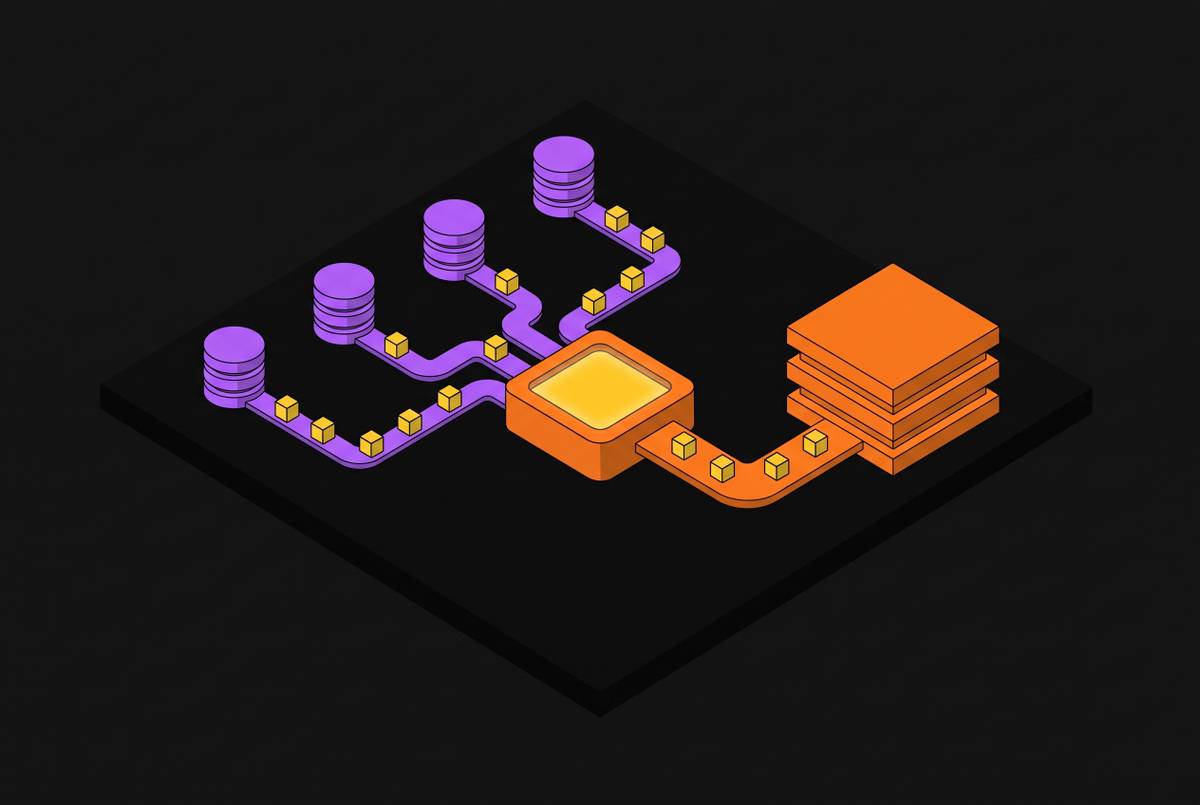
Qlik Replicate supports fan-in CDC replication from multiple operational databases into a single warehouse, including Oracle, PostgreSQL, and MySQL sources feeding Snowflake. Its strength is the range of systems it connects through a mature log-based engine. The qualification is operational responsibility, because deployment, schema changes, recovery, and variable latency require evaluation before teams treat it as a managed service or commit to guaranteed sub-minute freshness.
What Qlik Replicate is and how its CDC engine works
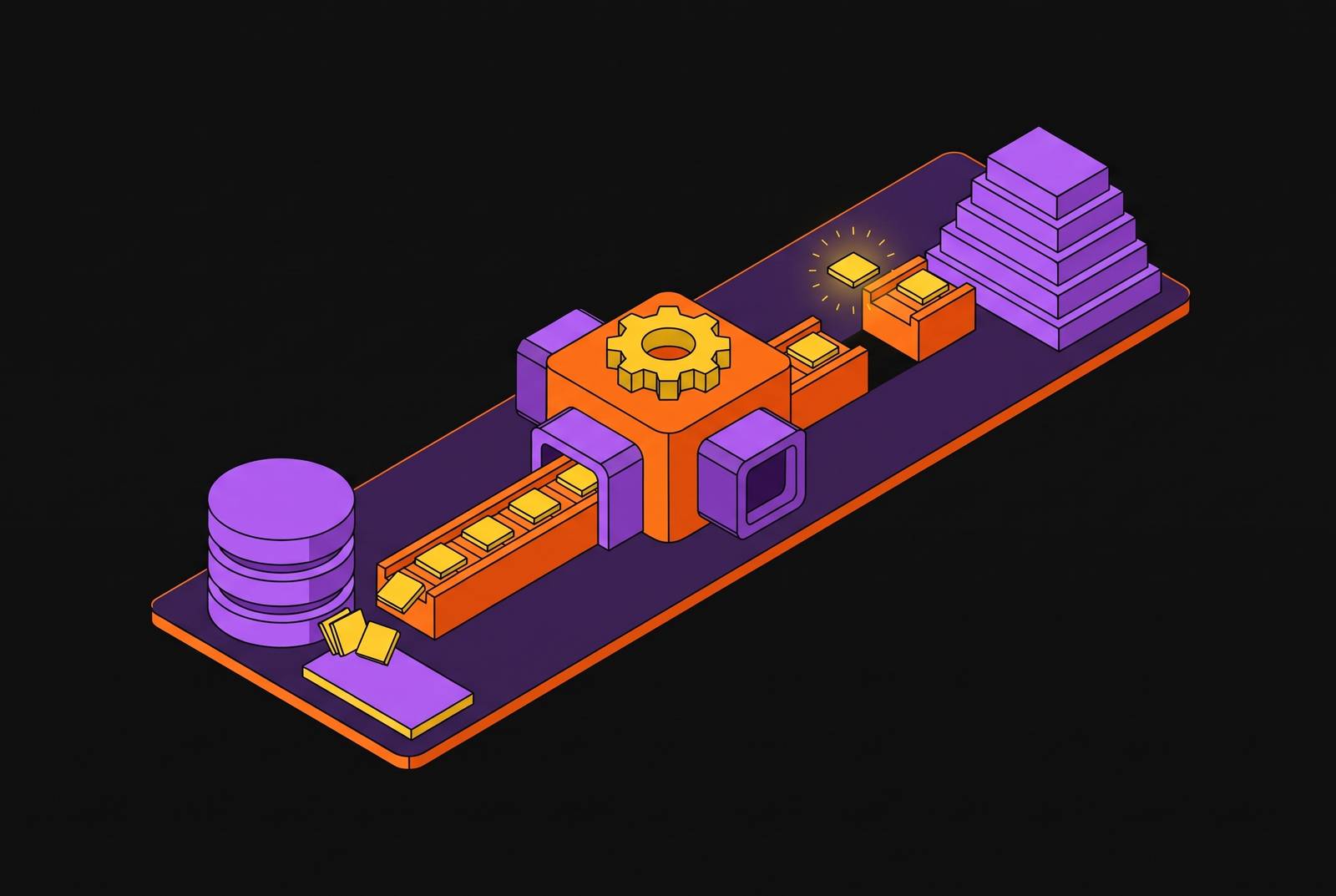
Qlik Replicate is an enterprise data replication product that captures changes by reading database transaction logs. It captures inserts, updates, and deletes in order and puts very little load on the source system. Hard deletes are captured through the log as well. Qlik describes the approach as “log based and zero footprint”, meaning that no agent is required on the source or target by default. The engine interacts with those systems through standard protocols and transaction logs.
A replication task defines a source endpoint, a target endpoint, optional transformations, and error-handling rules. An initial full load establishes the baseline. The task then transitions to CDC for ongoing changes, with processing behavior shaped by the target and the chosen mode. Transactional mode preserves commit order for strict referential integrity, while batch-optimized mode groups transactions for efficient warehouse ingestion. Data warehouse-optimized mode uses native APIs for MPP warehouses such as Snowflake and Azure Synapse. Message-oriented streaming mode publishes change records to Kafka and similar brokers, so the destination shapes how the system works as well as where it sends data.
How does Qlik Replicate consolidate multiple production databases into one Snowflake warehouse?
The fan-in pattern uses source-specific replication tasks directed at a shared warehouse target. For five production databases, the architectural unit remains the task with its source and target endpoints. Qlik Replicate supports relational sources including Oracle, SQL Server, Db2, MySQL, and PostgreSQL, as well as MongoDB. That breadth extends beyond conventional application databases. The SAP and mainframe connectors built for those systems bring them into the same product, saving the specialized integration work they would otherwise need.
The SAP connector is a substantial differentiator because it captures and translates complex SAP data formats through an automated interface. For enterprises using SAP as their ERP backbone, this is more useful than a connector count alone suggests. Target schema generation also reduces initial setup work. The product generates schemas from source metadata, and its graphical interface allows configuration without manual coding. Qlik Enterprise Manager provides real-time monitoring of hundreds of replication tasks, with alerts and performance KPI dashboards.
Qlik’s May 2026 release added an IBM IMS source endpoint, an IBM Db2 for LUW target endpoint, and a Cloudera Iceberg target. It also added support for MariaDB 11.8, Kafka 4.1, and Kafka 4.2. Connector development is therefore an active part of the product. These additions show which endpoints are supported, but they do not prove throughput or how easy every combination of endpoints is to run.
The deployment model and what “enterprise-grade” actually requires from teams
Qlik Data Integration is client-managed and can be installed on-premises or as a virtual machine image that the customer hosts. Qlik Cloud Data Integration is a separate Qlik-managed Enterprise Integration Platform as a Service, or eiPaaS. The distinction changes who operates the infrastructure. Buyers must establish which products their purchase includes before assigning deployment, configuration, and recovery responsibilities.
A team that already runs enterprise middleware will know this model, while a lean data team may have more servers to manage than it can handle. “Zero footprint” on the endpoints describes a boundary of responsibility that still leaves infrastructure to manage. For teams that want a managed service to replicate Oracle, PostgreSQL, and MySQL at the same time, how it is deployed matters as much as which connectors it has. A product’s replication capability and the service under which it is operated are separate buying decisions.
Qlik’s support matrix is the authoritative reference for available sources and targets, particularly SAP and mainframe systems. Product summaries are not sufficient for that decision. Buyers also need to check licensing because capacity-band pricing has no published list prices. Buyers must account for licensing terms that can constrain actual capacity utilization, even when the engine’s technical capabilities appear suitable.
Schema evolution: what Qlik Replicate handles automatically and where it breaks
Qlik Replicate dynamically propagates common source DDL changes, including new columns, column changes, data type changes, and table additions. This automation reduces routine work, but it is conditional. Creating a target schema during setup is one job, and keeping it in step with later changes is another. Qlik’s documentation says that major schema changes can cause the migration task to fail entirely if changes to the source and replication configuration are not kept in step.
Qlik’s May 2025 patch resolved a specific failure involving transformation rules. After a rule changed, resuming a CDC-only task could trigger a table reload. For large schemas, that was a costly interruption. The patch is evidence both that the defect existed and that this particular behavior was addressed. It illustrates how configuration changes can affect a task beyond its intended transformation logic.
A practical mitigation is a change management pipeline with automated testing and approvals for source schema modifications. Under that approach, replication of the changes follows a green light. This adds process overhead to the automation. Teams with schema drift that happens often or without warning, including those with fast-moving SaaS and e-commerce applications, thus have more work to do than teams whose source structures change through controlled releases.
Latency in practice: the gap between “near real time” and sub-minute guarantees
Even when schemas remain aligned and replication runs correctly, latency is not fixed. Qlik Replicate can keep latency low under normal conditions, but the result depends on transaction volume, transformation load, and configuration. The governing constraint is the rate of change. When incoming changes exceed the rate at which the engine can read the transaction log, replication lag grows. E-commerce and financial transaction environments are especially exposed to the consequences because delayed changes weaken the usefulness of real-time analytics.
In-flight transformations give the engine more work to do. For large or complex transformations, the recommended approach is to load raw data into a staging area and use a separate ELT tool. This separates replication from heavier transformation work. It also means that Qlik Replicate should not be evaluated as the complete transformation layer merely because tasks support optional transformations. Latency must be assessed across the path the application actually needs.
The lesson for evaluation is to pressure-test “near real time” against the intended transaction volume and transformation workload before committing. The engine can deliver low latency in ordinary operation without a documented sub-minute guarantee. It means a freshness requirement must be assessed as a workload-specific commitment.
Pipeline reliability, failure recovery, and the full-reload problem
Connection-loss recovery is a more disruptive concern than ordinary replication lag. The full-reload-on-reconnect behavior identified for Qlik Replicate requires a table reload to re-sync after a replication connection is lost. Large tables make that recovery especially costly. Recovery returns to bulk data movement, a substantial change from the incremental delivery of routine CDC. When teams assess how much work they can handle, they must include failure recovery as well as steady-state throughput.
Qlik’s December 2025 changelog introduced a meaningful improvement through the Data Integration projects API. The update supports resuming a Replication task from a specified timestamp, position, or locally stored checkpoint. However, an API capability at the Data Integration project level should not be treated as proof that every Qlik Replicate deployment avoids full reloads after connection loss. Its relevance depends on the purchased product and the recovery path available to that deployment.
Qlik’s May 2025 patch also documented a log stream replication task that could stop capturing changes without returning an error. Active monitoring is therefore part of operating the pipeline alongside recovery planning.
Database-specific replication mechanics and where bugs surface
The graphical task model hides differences in how the engine works with each source. PostgreSQL replication reads the WAL through logical replication, which is the standard approach. Mismanaged slots can cause WAL bloat and can crash the source database, a risk shared by Qlik Replicate and other log-based PostgreSQL tools.
Oracle illustrates a different class of risk at the log-parsing layer. Qlik’s May 2025 patch addressed missing target records caused by an HCC page type in Redo Log 11.26 Multi Insert operations. The defect was specific, and it was addressed. Its significance is that “log-based CDC” does not describe one uniform implementation across databases. Oracle redo-log parsing needs work at the byte level that is specific to the database, so getting the data right depends on details hidden by the task interface.
Source coverage has similar limits of abstraction. Available product documentation does not establish DynamoDB as a supported Qlik Replicate source. Teams using it should check the current matrix before planning a migration. The purpose-built SAP and mainframe connectors remain valuable, but their availability likewise depends on the supported endpoint.
How Qlik Replicate fits real-time AI and analytics use cases — and where it stops short
Qlik Replicate can feed AI and analytics pipelines through Kafka and multi-target routing. CDC-to-Kafka is a legitimate pattern for microservices, event-driven applications, and real-time ML workloads. Having more than one consumer can also support data mesh architectures. These capabilities place the engine upstream of modern applications without making it the entire application data platform. Its main job is to replicate data faithfully, while downstream systems handle the uses of that data.
Qlik’s June 2025 announcement described continuous CDC into Databricks Unity Catalog’s managed Iceberg tables for low-latency ingestion supporting strict business SLAs across Delta and Iceberg formats. The Uniform table CDC and Iceberg optimization capabilities were in private preview at that time. Release status qualifies the integration claim. It provides a concrete lakehouse path for AI-ready data, but a private-preview announcement is not a general freshness guarantee for every production pipeline.
Qlik Replicate does not include an ELT or complex transformation engine and does not support reverse ETL, so transformation and operational sync require separate tools. Teams also have to configure parallelization and resource constraints by hand because the product has no automatic tuning or prediction for them. For AI agents and customer-facing dashboards that require sub-minute delivery as a baseline, the documentation does not explicitly establish that minimum service level. A valid integration pattern is therefore not, by itself, sufficient evidence that the freshness requirement will be met.
Who Qlik Replicate is genuinely the right fit for — and who should look elsewhere
Qlik Replicate is a strong fit for organizations that need broad source coverage, especially SAP, mainframe, and Oracle, and have the expertise to operate and tune a self-managed replication server. Fan-in to a single warehouse is a credible use case. The buying criteria are the exact endpoint support, deployment ownership, licensed capacity, schema-change process, recovery behavior, and workload-specific latency.
Teams needing a documented sub-minute SLA should look elsewhere if that requirement cannot be established for the proposed deployment. The same applies to teams without capacity for server management and failure recovery, or whose rapidly evolving schemas make coordinated changes impractical. For AI agents and real-time customer-facing features, stale data can have a direct product cost. Those teams need freshness to be a dependable operating condition. The decision turns on whether the organization can support the operating model required by the capability it is buying.