Top 5 real-time data pipeline platforms for AI applications
Stale data kills AI models in production faster than bad architecture ever will.
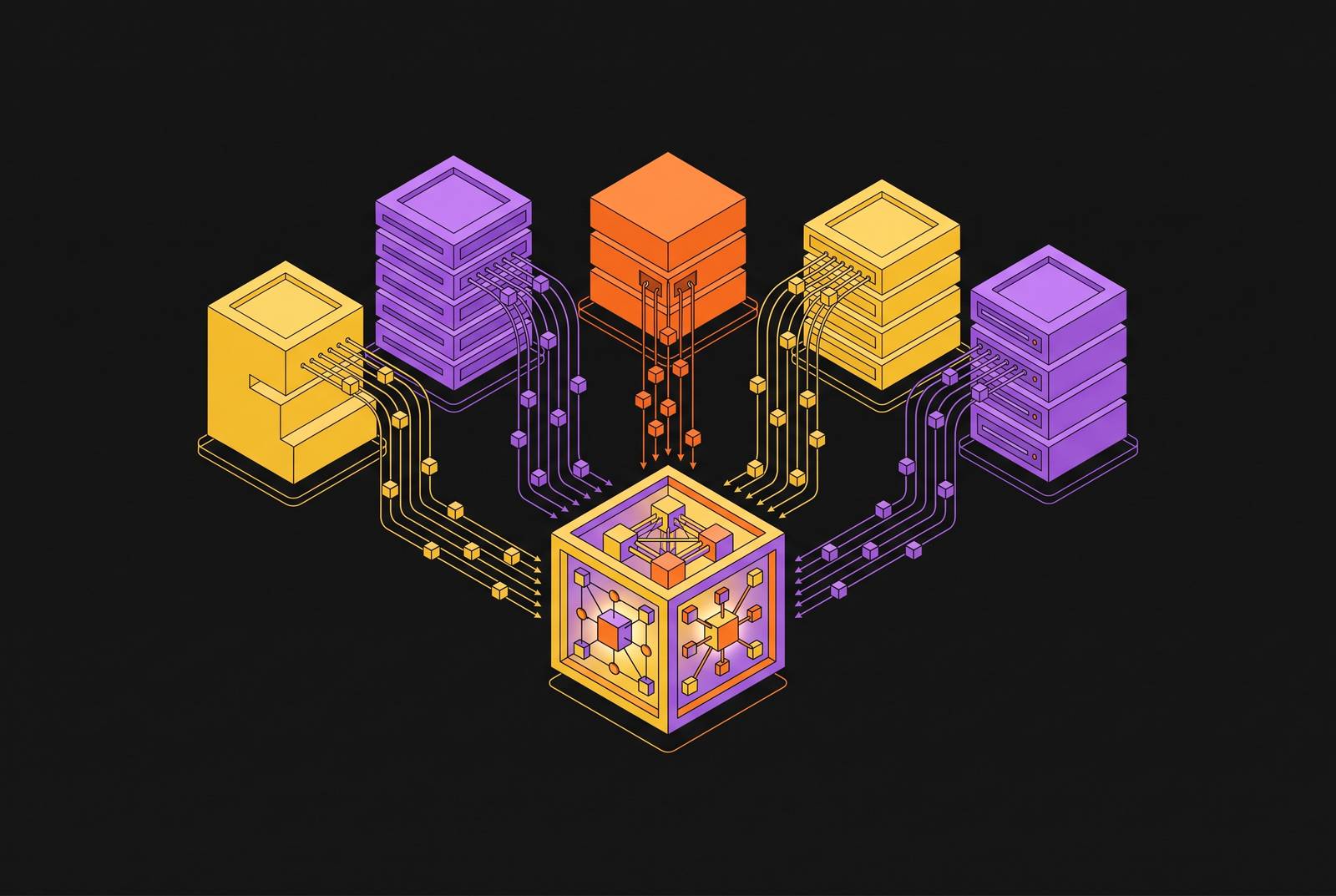
AI applications fail in production for a reason most teams don't expect. The model is fine. The data feeding it is stale. A fraud model that fires six hours after a transaction, or a recommendation engine serving a restaurant that closed that afternoon, has already failed regardless of how sophisticated its architecture is. This guide examines the five real-time data pipeline platforms that close that gap, and the framework for choosing among them.
Why AI applications break when data pipelines are slow
The problem is structural. Most data teams still run batch pipelines that sync on a schedule, and for dashboards and weekly reports, that cadence is perfectly acceptable. For AI inference, agent memory, and feature stores, it is not. When a model acts on data that is hours or days old, the result is a correct answer to a question nobody is asking anymore. Three failure modes make this concrete:
- Fraud detection that fires after money has already moved
- A personalization engine reflecting yesterday's behavior rather than the last click
- A RAG copilot answering from a product catalog or ticket history that no longer reflects what exists
The fix is not a better model. It is a pipeline that moves data from operational systems to the systems models depend on in seconds rather than hours. Two families of platform tackle that problem in different ways, and the distinction determines which tool any given team should choose.
The two families of real-time pipeline and why the distinction matters for AI
Choosing a platform without understanding the two families of real-time pipelines leads teams to solve the wrong problem.
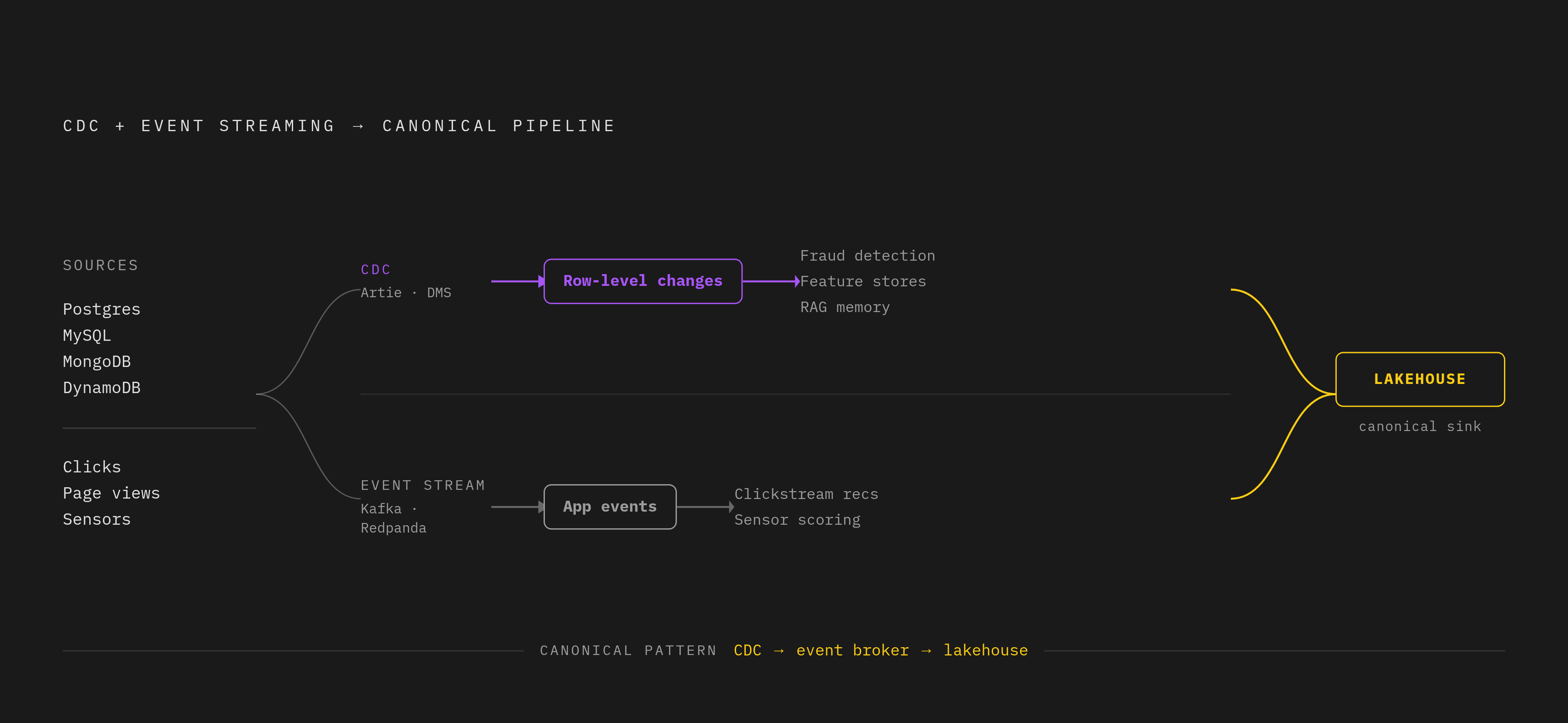
- CDC-first platforms capture row-level changes from operational databases such as Postgres, MySQL, MongoDB, and DynamoDB, then continuously reflect them into analytical destinations. That is the right fit when AI models train on or query database state directly.
- Event-streaming platforms move high-throughput application events such as clicks, page views, and transaction records through a broker into downstream consumers. That pattern serves real-time inference pipelines fed by clickstream or sensor data, where the event is the input rather than a change to a stored record.
Many production AI stacks combine both families, with CDC keeping the warehouse current while an event broker handles high-frequency application events. The canonical pattern is CDC into an event broker into a lakehouse. Fraud detection and feature stores belong in the CDC family. Clickstream recommendation pipelines belong in the event-streaming family. RAG and agent memory often need both.
How to read the five platforms below
The right platform is not the most powerful one. It is the one that fits the AI architecture and the operating model of the team building it. Four questions resolve most selection debates before they start:
- What data must be fresh, and how fresh must it be?
- Where does that data originate?
- Which downstream systems need to consume it?
- How much infrastructure is the team actually prepared to operate?
Answer those questions first, and the platform choices below stop looking like a flat inventory and start looking like a short list.
1. Artie: managed CDC replication built for production AI workloads
Best for: Teams whose AI applications depend on current operational database state — feature stores, training datasets, and real-time dashboards where even minutes of lag degrade output quality.
Artie Transfer streams changes via CDC from operational databases including Postgres, MySQL, MongoDB, and DynamoDB, then merges them directly into destination tables in Snowflake, BigQuery, Redshift, Databricks, and ClickHouse. Sub-minute latency arrives without a Kafka cluster or consumer code to maintain.
Key strengths:
- Automatic schema evolution: Handles DDL changes including column additions, table renames, and type changes without crashing or failing silently.
- Non-disruptive backfills: Backfills run without pausing replication, and built-in observability surfaces lag before a model starts training on malformed data.
- Dual pipeline coverage: Beyond CDC, Artie also offers an Events API for streaming event data into the same destinations, covering both pipeline families from a single managed platform.
Honest scope: Artie is primarily focused on database replication and event ingestion into warehouses and databases. It is not a general-purpose event streaming broker, and teams that need Kafka-style fan-out to many heterogeneous consumers will evaluate it alongside one rather than as a replacement for one.
2. Integrate.io: low-code CDC and AI-native pipeline management
Best for: Teams that need real-time CDC pipelines but lack the engineering bandwidth to operate infrastructure, and teams building AI agent workflows that need to inspect and execute pipelines through natural language.
Integrate.io sits in the AI-native category through a dedicated Model Context Protocol (MCP) Server, which exposes pipeline management to AI agents via a protocol rather than a user interface. Key strengths:
- AI-native agent workflows: An AI agent can inspect, build, edit, validate, and execute pipelines using natural language — categorically different from a UI helper.
- Low-code orientation: Fits analytics engineers and operations teams who are not writing pipeline code.
- Broad connectivity: Addresses the actual constraint for AI initiatives that depend on consistent access across many systems more than deep Postgres WAL expertise.
Honest scope: The low-code approach trades some configurability for speed of setup. Teams with deep infrastructure requirements may find the abstraction limiting.
3. Redpanda: Kafka-compatible event streaming without the JVM overhead
Best for: AI pipelines that need to ingest and fan out high-throughput application events at very low latency, with Kafka compatibility but without the operational complexity of a JVM-based cluster.
Redpanda is written in C++ and drops the JVM and ZooKeeper entirely. Key strengths:
- Single binary deployment: Lower operational complexity than a standard Kafka cluster.
- Kafka-compatible API: Existing Kafka producers, consumers, and tooling work without modification — no rewrite required.
- Lower per-event latency: The right fit for real-time inference pipelines fed by clickstream, sensor, or transaction events where each millisecond of broker latency affects model freshness.
Honest scope: Redpanda is less suited to teams whose primary need is keeping a warehouse current from a Postgres database. That job belongs to the CDC family.
4. AWS DMS: the migration-era tool teams most often replace
Best for: One-time or infrequent database migrations within the AWS ecosystem, low-volume and low-criticality replication, and workloads where the destination is an AWS service and schema stability is guaranteed.
AWS DMS is the default starting point for many teams already inside the AWS ecosystem, and that default deserves scrutiny. Its architecture was optimized for full initial loads followed by basic CDC keep-up, not for the long-running, high-reliability replication that production AI pipelines demand. Key limitations:
- Silent retry behavior: Default settings can let a CDC task retry silently for up to thirty minutes before failing — a model training on quietly stale data is training on a lie.
- Migration-era design: Error handling reflects a one-time migration use case, not always-on AI pipeline workloads.
- Predictable replacement path: Teams that reach for DMS out of ecosystem familiarity and then ask it to run production AI pipelines will eventually replace it. Knowing that in advance saves the discovery period.
Honest scope: DMS is not a bad tool. It is a tool for a specific job, and long-running AI pipelines are not that job.
5. Apache Flink and Kafka: the composable open-source stack
Best for: Large engineering organizations with a dedicated ML platform function that need maximum control over custom real-time AI architectures and have the capacity to operate the infrastructure.
The canonical stack has three layers:
- Ingestion layer: Kafka or a compatible broker
- Stream-processing layer: Apache Flink or Spark Streaming
- Feature store layer: Feast, Tecton, or custom code that serves precomputed features to models
Key strengths:
- Maximum control: Proprietary streaming transformations, custom connectors, and full architectural flexibility.
- Ecosystem leverage: Teams already operating Kafka for application event buses can extend the same infrastructure to AI feature pipelines.
- No managed-service constraints: Workloads where transformation logic is too custom for any managed platform fit here.
Honest scope: Someone has to tune JVM settings, manage brokers, handle upgrades, and maintain schema registry. For a data team of four people, that is a full-time infrastructure project, not a pipeline configuration.
Matching platform to AI use case: a decision framework
No single platform is the right answer for every AI use case. The decision turns on three variables: what kind of data needs to move, how much latency the AI application can tolerate, and how much infrastructure the team can operate.
- Fraud detection, personalization engines, RAG copilots: Need a CDC-first platform. Artie is the managed option built specifically for this pattern.
- Clickstream recommendation, real-time sensor scoring: Need an event-streaming platform. Redpanda fits teams that want Kafka-compatible simplicity without the JVM burden.
- Maximum control with engineering capacity: The Kafka and Flink open-source stack.
- Limited infrastructure bandwidth, AI-native agent workflows: Integrate.io.
- AWS-native migrations at low volume: Start with DMS, with the expectation that long-running AI pipeline workloads will eventually require a replacement.
The default modern production pattern — CDC into a streaming layer into a lakehouse — is not a single-vendor solution. Artie handles the CDC and warehouse delivery layer, leaving the streaming and transformation layers to whatever tooling the team already runs. The framework is not a ranking. It is a routing decision, and the routing depends on the data, the latency, and the team.
Schema evolution and failure recovery: the operational requirements that separate production pipelines from demos
A pipeline that works in staging and fails silently in production because a developer added a column is not a real-time pipeline. It is a time-delayed failure. Schema evolution is the most common silent failure point, and it is not a rare event. When evaluating any platform, test for:
- Automatic schema evolution: Sub-60-second replication latency and automatic handling of DDL changes are first-order criteria. A CDC tool that breaks when developers rename a column has already failed the production AI workload it was meant to serve.
- Checkpointing: Allows a CDC system to resume from the last confirmed position after a network failure or restart. The Postgres replication slot is the canonical crash-safe cursor.
- Dead-letter queues: Route messages that fail processing repeatedly out of the main pipeline instead of blocking it, so a single malformed event cannot halt downstream AI model updates. Dead-letter queues are the complementary safeguard to checkpointing.
- Exactly-once delivery semantics: Prevent duplicate processing, with idempotent merge patterns at the destination as the production implementation of that guarantee.
Test schema evolution handling and failure recovery explicitly rather than taking vendor claims at face value.
Security and compliance requirements that apply to real-time pipelines, not just data stores
For teams in healthcare, fintech, or any regulated industry, the replication pipeline is not outside the compliance boundary. It is inside it. Key requirements to verify:
- SOC 2 Type II: Assesses whether controls operated effectively over months, not just whether they existed on the audit date. A pipeline that fails silently is a control failure, not just an engineering problem.
- HIPAA-compliant replication: Requires a Business Associate Agreement with the vendor, encryption of PHI in transit and at rest, role-based access controls, audit logs of data access and pipeline activity, and six-year retention compliance.
- Passthrough architecture: A replication pipeline should move data, not persist it. A managed service that buffers or retains customer data adds a compliance surface that must be assessed, audited, and governed separately.
- Vendor and supply-chain risk: Now a SOC 2 expectation rather than a procurement checkbox. Documented vendor tiering, onboarding, and continuous monitoring of subservice providers are expected practices.
The answer separates platforms that are ready for regulated production from those that are only ready for a demo.